Recruiters Have a Catch-All Problem Nobody Talks About
If you run talent acquisition for any company bigger than about 200 people, you already know this pain. You spend hours sourcing candidates on LinkedIn, building prospect lists in your ATS, and crafting personalized outreach sequences. Then 30 to 40 percent of your emails bounce or vanish into the void. The culprit is almost always catch-all domains, and recruiting is one of the industries hit hardest by them.
Corporate email addresses are the bread and butter of recruiter outreach. You are not emailing Gmail or Yahoo accounts. You are emailing firstname.lastname@bigcorp.com, and a huge percentage of those corporate domains are configured as catch-all. When a domain is set to catch-all, the mail server accepts every inbound email regardless of whether the specific mailbox exists. That means your standard email verification tool will mark john.smith@bigcorp.com as valid even if John Smith left the company two years ago.
This is the exact scenario that burns recruiter domains and tanks response rates.
Why Recruiting Lists Are Especially Vulnerable
Recruiting outreach has a few characteristics that make it uniquely exposed to the catch-all problem. First, you are almost exclusively emailing corporate domains. Consumer addresses are rare in talent acquisition. And enterprise companies, the ones with the best candidates, use catch-all configurations at rates above 40 percent.
Second, candidate data decays faster than almost any other type of B2B data. The average person changes jobs every 2 to 4 years, and in tech and finance, turnover is even faster. B2B email lists decay at roughly 2.1 percent per month, which means that a sourcing list you built in January could have 12 to 15 percent invalid addresses by June. When those addresses sit on catch-all domains, your verification tool cannot flag them as invalid.
Third, recruiters typically send high volumes of outreach. A single recruiter working on five or six roles might email 200 to 400 candidates per week. At those volumes, even a modest bounce rate accumulates reputation damage quickly. Gmail expects spam complaints to stay below 0.3 percent, and high-volume senders (5,000 or more per day) need to keep complaints under 0.1 percent.
The Math on What Catch-All Costs a Recruiting Team
Here is a concrete example. Say your sourcing team builds a list of 1,000 candidates for a series of engineering roles. Standard verification flags 600 as valid, 50 as invalid, and 350 as catch-all. Most teams either discard those 350 contacts entirely or send to them and hope for the best.
If you discard them, you just lost 35 percent of your pipeline. In a competitive hiring market, that is the difference between filling a role in four weeks and filling it in eight. If the average cost-per-hire for an engineering role is $4,000 to $5,000, and those discarded candidates include even a handful of strong matches, the revenue impact adds up fast.
If you send to all 350 without verification, catch-all addresses carry 30 to 50 percent higher bounce risk compared to standard verified addresses. You might see 100 or more bounces from that batch alone, pushing your overall bounce rate above 10 percent. At that level, domain reputation damage is almost guaranteed.
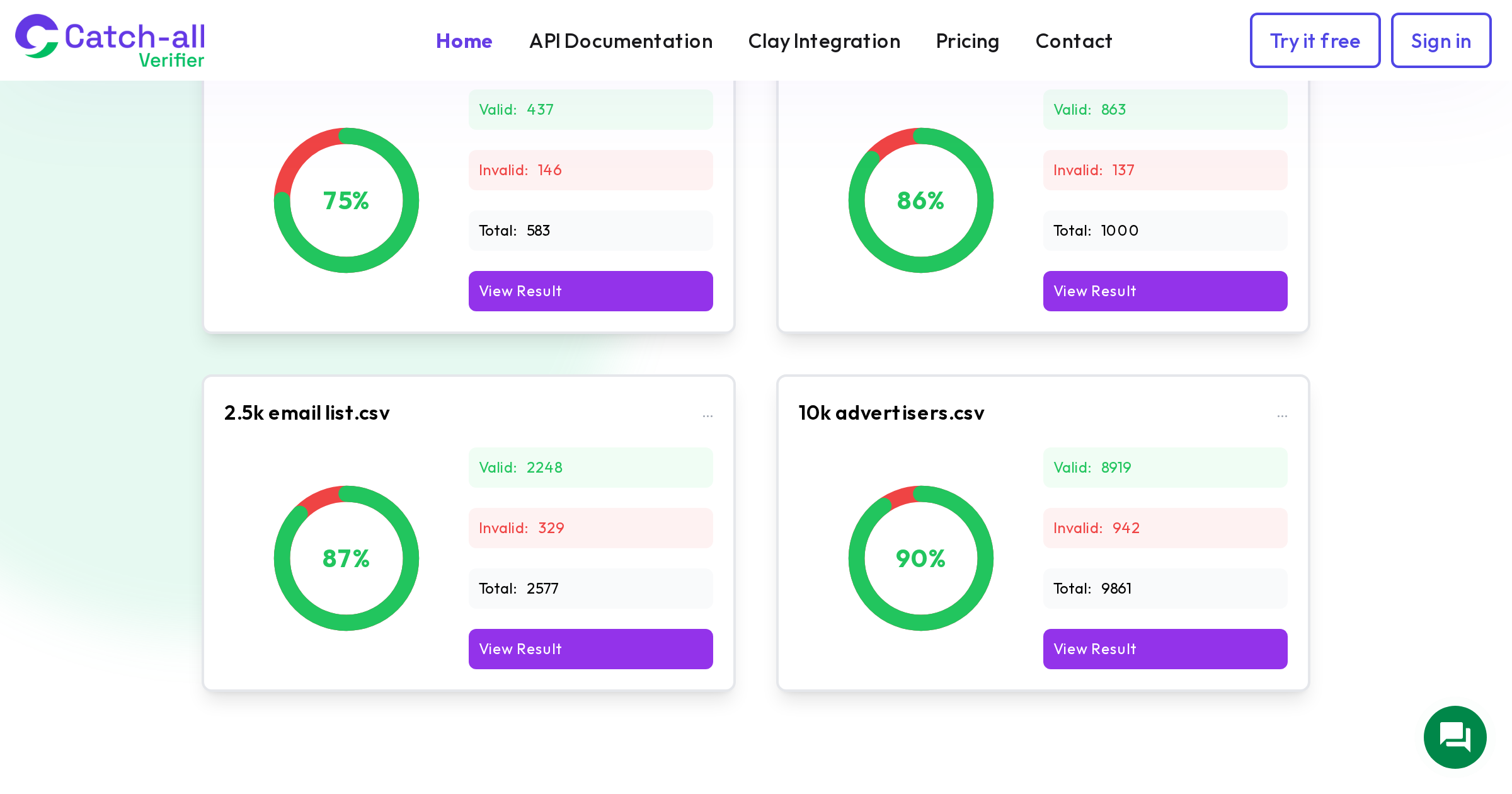
The third option is to run those 350 catch-all addresses through a specialized catch-all verification tool. Based on tested validation rates, roughly 75 to 90 percent of catch-all addresses turn out to be deliverable when properly verified. On a list of 350, that means 260 to 315 valid, sendable candidate emails recovered. At a cost of roughly $0.005 to $0.007 per verification, you are spending under $2.50 to recover 260-plus contacts.
How Catch-All Verification Fits Into the Recruiting Workflow
The best place to insert catch-all verification is between your sourcing step and your outreach step. Here is what a clean workflow looks like:
- Step 1: Source candidates. Pull contacts from LinkedIn, your ATS, job boards, or referral lists.
- Step 2: Run standard email verification. This removes clearly invalid addresses, disposable emails, and syntax errors. It also labels catch-all addresses.
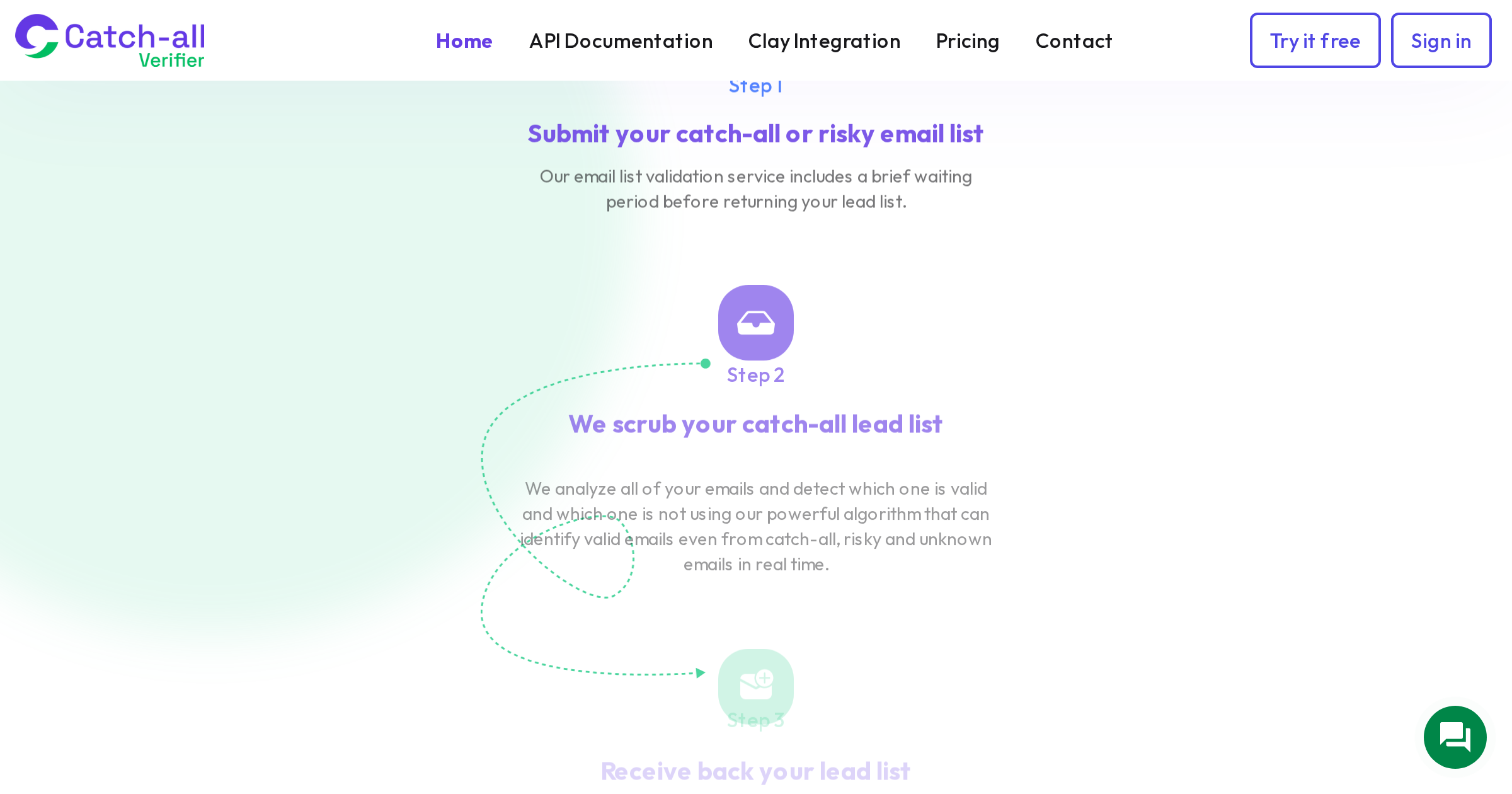
- Step 3: Route catch-all addresses to specialized verification. Take everything flagged as catch-all and run it through a tool like CatchallVerifier that actually resolves whether the specific mailbox exists.
- Step 4: Segment your outreach. Send to verified-valid addresses normally. Send to high-confidence catch-all verified addresses with slightly more conservative pacing. Suppress anything that fails both rounds of verification.
This workflow adds maybe 15 minutes to your list preparation process and costs a few dollars per thousand candidates. The payoff is a dramatically larger sendable pool and a much lower bounce rate.
ATS Integration Considerations
Most applicant tracking systems do not have native catch-all verification. Greenhouse, Lever, Ashby, and Workday all let you import candidate lists, but none of them distinguish between a verified email and a catch-all address. This means verification needs to happen outside your ATS, either as a manual CSV workflow or through an API integration.
If your team uses a sequencing tool like Gem, Hireflow, or even a general outreach platform like Instantly or Smartlead for recruiting, the API approach is more practical. You can set up a verification step that runs automatically when new candidates are added to a sequence. The CatchallVerifier API returns results in real time, so there is no delay in your outreach cadence.
For smaller teams that rely on CSV uploads, the process is straightforward: export your candidate list, upload to a bulk verification tool, download the results, and filter before importing back to your ATS. The whole cycle takes about an hour for a list of 1,000 candidates, most of which is processing time rather than hands-on work.
Candidate Experience Implications
There is an angle here that goes beyond deliverability metrics. When a recruiter email bounces, that candidate never gets the message. If you are sourcing passive candidates for hard-to-fill roles, every missed contact is a missed opportunity. Unlike marketing where you can make up for lost contacts with volume, recruiting often targets specific individuals who are not interchangeable.
Worse, if your domain reputation suffers because of high bounce rates, even your emails to valid addresses start landing in spam. You might be reaching 80 percent of your candidate list today, but if ongoing bounce damage pushes your inbox placement down, that number could drop to 50 or 60 percent without you realizing it. The global average inbox placement rate is 83.1 percent, and senders with low reputation scores see less than 50 percent inbox placement.
From the candidate side, getting a recruiting email that is relevant and well-timed is a positive experience. Getting nothing because the email bounced, or finding a legitimate opportunity buried in spam, is a negative one. Catch-all verification directly improves candidate experience by ensuring your outreach actually reaches the people you are targeting.
Handling Different Recruiting Scenarios
Not all recruiting outreach is the same, and the catch-all challenge varies by scenario.
Executive Search
Executive candidates are at large enterprises with the highest catch-all rates (40 percent or more). The prospect pool is small and each contact is high-value. Discarding catch-all addresses in executive search is especially costly. Verifying every catch-all address is worth it at this level, even if you are only sourcing 50 candidates for a VP role.
High-Volume Technical Recruiting
When you are sourcing hundreds of software engineers, the catch-all percentage is usually lower (20 to 30 percent) because many tech companies use Google Workspace with catch-all disabled by default. But the volume means even a small percentage of bounces adds up. Batch verification before each outreach cycle keeps your domain clean.
Campus and University Recruiting
Education domains have among the highest catch-all rates, sometimes 40 to 60 percent for .edu domains. University email systems are also notoriously slow to deactivate accounts after students graduate. If you are doing campus recruiting, expect a higher baseline of catch-all addresses and plan your verification budget accordingly.
Agency Recruiting
Staffing agencies manage outreach across multiple clients and roles simultaneously. The combined volume can easily exceed 5,000 emails per day across all recruiters, which puts you in Gmail and Yahoo high-volume sender territory. At that scale, maintaining bounce rates below 2 percent is not optional. Catch-all verification becomes a cost of doing business rather than a nice-to-have.
Re-Verification Cadence for Recruiting Lists
Because candidate data decays at roughly 2.1 percent per month, any sourcing list that is more than 60 to 90 days old needs re-verification before you email it again. This is especially true for candidate pools you maintain over time, like talent communities or silver medalist lists from previous searches.
A practical cadence looks like this:
- Fresh sourcing lists (under 30 days old): Verify once before first outreach. No re-verification needed.
- Talent pools (30 to 90 days): Re-verify catch-all addresses before any new campaign. Valid addresses from the initial check are probably still good.
- Archived candidate lists (90 days or older): Full re-verification of the entire list. At 2.1 percent monthly decay, a six-month-old list could have 12 percent or more invalid addresses.
Measuring the Impact
Track these metrics before and after adding catch-all verification to your recruiting workflow:
- Bounce rate: Should drop from 5 to 10 percent to under 2 percent.
- Sendable pool size: Should increase by 15 to 30 percent as previously discarded catch-all addresses become usable.
- Response rate: Should improve as better inbox placement means more candidates actually see your messages.
- Cost per candidate contacted: Should decrease since you are reaching more people from the same sourcing effort.
- Domain health: Check Google Postmaster Tools for your recruiting domain. Reputation should stabilize or improve.
For recruiting teams sending more than a few hundred emails per week, catch-all verification is one of the highest-ROI investments you can make in your outreach infrastructure. The cost is measured in dollars. The return is measured in hires.