
Most marketers throw around the $36-per-dollar ROI figure for email marketing like a badge of honor. And it is impressive. Litmus and DemandSage have both confirmed it, with retail brands pushing that number to $45 per dollar spent. Some companies, roughly 1 in 5 according to DemandSage, even hit a staggering 7,000% return, or $70 back for every dollar in.
But here is the thing nobody talks about: that ROI calculation assumes your emails actually reach inboxes. Every bounced email, every message that lands in spam, every send wasted on an invalid address drags that number down. And if 15 to 40 percent of your B2B list sits in catch-all limbo, labeled but unresolved by your verification tool, you are leaving a massive chunk of potential revenue completely untouched.
The Math Behind Wasted Sends
Let us break this down with real numbers. Say you have a list of 50,000 contacts. You are spending $0.005 per email send through your ESP, and your average revenue per delivered email is $0.18 (a conservative figure based on typical B2B email performance).
If your list is unverified, industry data shows only about 62% of all submitted email addresses are actually valid, according to ZeroBounce. That means roughly 19,000 of your 50,000 addresses could be problematic. Some will hard bounce. Some will hit spam traps. Some will simply never reach a real person.
The direct cost of sending to those 19,000 bad addresses is $95 in wasted send credits. Not catastrophic on its own. But the indirect costs are where it gets painful.
The Reputation Tax
Every hard bounce chips away at your sender reputation. Google Postmaster Tools rates domains on a scale from High to Bad. Senders with a score equivalent to 90 or above see around 92% inbox placement, according to Warmy. Drop below a score of 70, and you are looking at less than 50% inbox placement.
That means half your remaining good emails, the ones going to valid addresses, start disappearing into spam folders. Your $36 ROI just became $18 or worse. And the compounding effect is brutal: fewer emails in inboxes means less engagement, which further degrades your reputation, which pushes even more emails to spam.
Where Catch-All Addresses Fit In
Standard email verification tools like ZeroBounce and NeverBounce do a solid job with clearly valid and clearly invalid addresses. They catch syntax errors, dead domains, and known bad mailboxes with 97 to 99% accuracy on those categories.
The problem is catch-all domains. When a domain is configured as catch-all, the mail server accepts every incoming email regardless of whether the specific mailbox exists. Standard SMTP verification asks the server if a mailbox exists, and the server always says yes. So your verification tool labels the address as catch-all and moves on.
For your 50,000-person list, that means somewhere between 7,500 and 20,000 addresses (15 to 40% based on multiple industry sources) get stuck in this gray zone. Most marketers either skip them entirely, losing potential revenue, or send to all of them, risking bounces and reputation damage.
The Verification Multiplier Effect
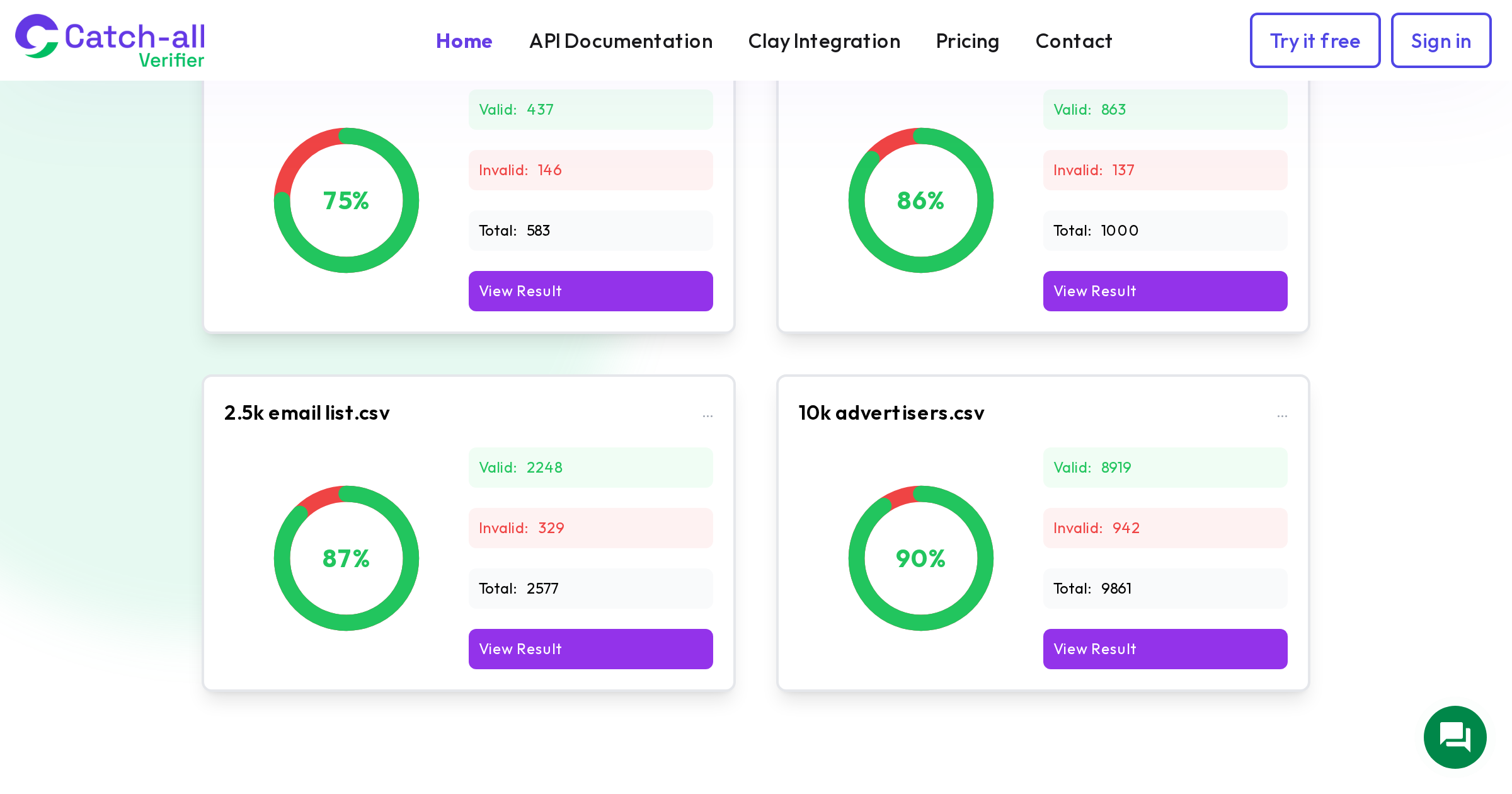
Specialized catch-all verification changes this equation entirely. CatchallVerifier uses proprietary methods beyond the standard SMTP handshake to determine which specific addresses at catch-all domains are actually deliverable. Their tested results show 75 to 90% of catch-all addresses come back as valid across different list types.
Running those numbers: if you have 10,000 catch-all addresses on your list and 80% verify as valid, you just recovered 8,000 sendable contacts that standard verification left in limbo. At $0.18 revenue per delivered email, that is $1,440 in potential revenue you would have otherwise abandoned.
The verification cost? At CatchallVerifier pricing, verifying 10,000 addresses costs roughly $49 on the Popular plan. So you are spending $49 to unlock $1,440 in potential revenue. That is a 29x return on the verification spend alone.
Automated Workflows Amplify the Stakes
The impact of list quality gets magnified when you layer in automation. EmailMonday reports that automated email workflows generate 320% more revenue than non-automated campaigns. That is a 30x higher return when everything is working properly.
But automation is a double-edged sword. Clean data flowing through automated sequences means compounding positive engagement signals. Your welcome series hits real inboxes, generates opens and replies, and builds sender reputation with every cycle. Gmail sees consistent engagement and rewards you with better placement.
Dirty data flowing through those same automated sequences means compounding damage. Invalid addresses trigger bounces on autopilot. Catch-all addresses that should have been verified bounce at higher rates, 27 times more likely than standard verified ones according to verified.email. And because the sequences run automatically, the damage accumulates before anyone notices.
The Re-Verification Revenue Recovery
Email lists decay at 22 to 30% per year, with B2B lists losing about 2.1% per month at baseline according to Marketing Sherpa. That means even a perfectly clean list degrades continuously. The contacts you verified six months ago have changed jobs, switched companies, or abandoned email addresses.
For a list of 100,000 contacts, 2.1% monthly decay means roughly 2,100 addresses go bad every month. Over a quarter, that is 6,300 contacts. If you are sending monthly campaigns at $0.18 per delivered email, those degraded contacts represent $3,402 in lost quarterly revenue potential, assuming they would have been reachable with fresh verification.
Regular re-verification, especially of catch-all segments that are more volatile, prevents this slow bleed. The cost of re-verifying your catch-all segment quarterly is minimal compared to the revenue protected.
Calculating Your Personal ROI Multiplier
Here is a framework you can apply to your own situation:
- Count your catch-all addresses. Run your list through any standard verification tool. Note how many come back as catch-all or accept-all.
- Estimate your recoverable contacts. Multiply your catch-all count by 0.75 to 0.85 (the typical valid rate from specialized catch-all verification).
- Calculate recovered revenue potential. Multiply recoverable contacts by your average revenue per email. If you do not know this number, use your total email revenue divided by total emails delivered over the same period.
- Compare to verification cost. Check CatchallVerifier pricing: $35 for 5,000 credits, $49 for 10,000, $119 for 25,000. Credits never expire, so there is no waste.
- Factor in reputation protection. This is harder to quantify but consider: maintaining inbox placement above 90% versus dropping below 50% essentially doubles your effective email reach. Every percentage point of inbox placement translates to real revenue.
What High Performers Do Differently
Companies hitting that top-tier 7,000% ROI from email are not just writing better subject lines. They are obsessive about list quality. Their workflows look something like this:
Every new contact gets verified at point of entry, whether that is a web form, CRM import, or enrichment tool output. Catch-all addresses get routed to specialized verification rather than being discarded or sent to blindly. The list gets re-verified on a regular cadence, with catch-all segments getting checked more frequently because they are more volatile.
Sending goes to the most engaged and most recently verified segments first, building positive engagement signals that improve placement for subsequent sends. Bounce rates stay below 1%, well under the 2% safety threshold. Spam complaints stay below 0.1%, clearing Google and Yahoo requirements with room to spare.
The Compounding Effect of Clean Data
The real power of verification is not in any single send. It is the compounding effect over time. A sender who consistently hits real inboxes builds a reputation that makes future sends more likely to land in the primary inbox. Gmail, Yahoo, and Microsoft all use engagement history to score future deliverability.
That means a 5% improvement in list quality today does not just improve this week's results. It improves next week's results, and next month's results, as your reputation score climbs. Senders maintaining bounce rates under 1.5% see 10 to 12% higher inbox placement over time according to Landbase.
Over a year, that 10 to 12% improvement in inbox placement applied across every campaign to your full list adds up to a substantial revenue difference. For a 100,000-contact list sending monthly at $0.18 per email, a 10% inbox placement improvement means roughly $21,600 in additional annual revenue, just from emails that now reach the inbox instead of the spam folder.
Bottom Line: Verification Is Not a Cost
The framing matters. Email verification, especially specialized catch-all verification, is not a line item expense. It is a multiplier on your entire email program. When your list is clean and your catch-all addresses are resolved, every dollar you spend on email infrastructure, content creation, and campaign management works harder because it reaches more real inboxes.
At $0.0049 to $0.007 per verification credit with CatchallVerifier, the math is almost absurdly lopsided. The question is not whether verification pays for itself. It is how much revenue you are currently losing by not doing it thoroughly enough.