You Paid for Verified Data and It Still Bounces
There is a specific frustration that sales teams experience after spending thousands on data enrichment platforms. You pull 5,000 leads from Apollo or ZoomInfo, the platform marks them as verified, you load them into your sequencing tool, and within the first few sends you are looking at a 5 to 8 percent bounce rate. Sometimes higher. Your domain reputation takes a hit, your deliverability drops, and you start wondering what exactly you paid for.
The answer comes down to a gap in how these platforms define verification. Apollo claims 91 percent accuracy on its database overall. ZoomInfo publishes similar numbers. Those figures are real, but they measure something different from what most sales teams assume. These platforms verify that an email address follows the correct format, that the domain exists, and that the mail server is accepting connections. What they do not do, in most cases, is resolve catch-all addresses into individual valid or invalid mailboxes.
The Catch-All Blind Spot in Enrichment Platforms
When Apollo or ZoomInfo encounters a catch-all domain, their verification system gets back a positive response from the mail server for every address they test. The server says yes to everything. So the platform marks the address as deliverable or verified, because technically the server accepted it. But the specific mailbox behind that address might not exist at all.
This is not a bug or a flaw in these platforms. It is a fundamental limitation of standard SMTP verification when applied to catch-all domains. And catch-all domains are not rare. About 30 percent of businesses use catch-all email configurations, and the percentage jumps to 40 percent or higher among enterprise companies. If your prospect list targets mid-market and enterprise accounts, you can expect 25 to 35 percent of your leads to sit on catch-all domains.
That means for a list of 5,000 leads from Apollo, somewhere between 1,250 and 1,750 addresses are on catch-all domains. Apollo marks most of these as verified. But within that batch, a meaningful percentage are actually undeliverable. The person left the company, the specific alias was never set up, or the address was guessed using a pattern that does not match the real mailbox format.
What Apollo Actually Tests
Apollo runs through a standard verification sequence for its email data. It checks syntax, confirms the domain has valid MX records, and performs an SMTP handshake to see if the server accepts the address. For non-catch-all domains, this works well. The server either confirms or denies the mailbox, and Apollo can label it accordingly.
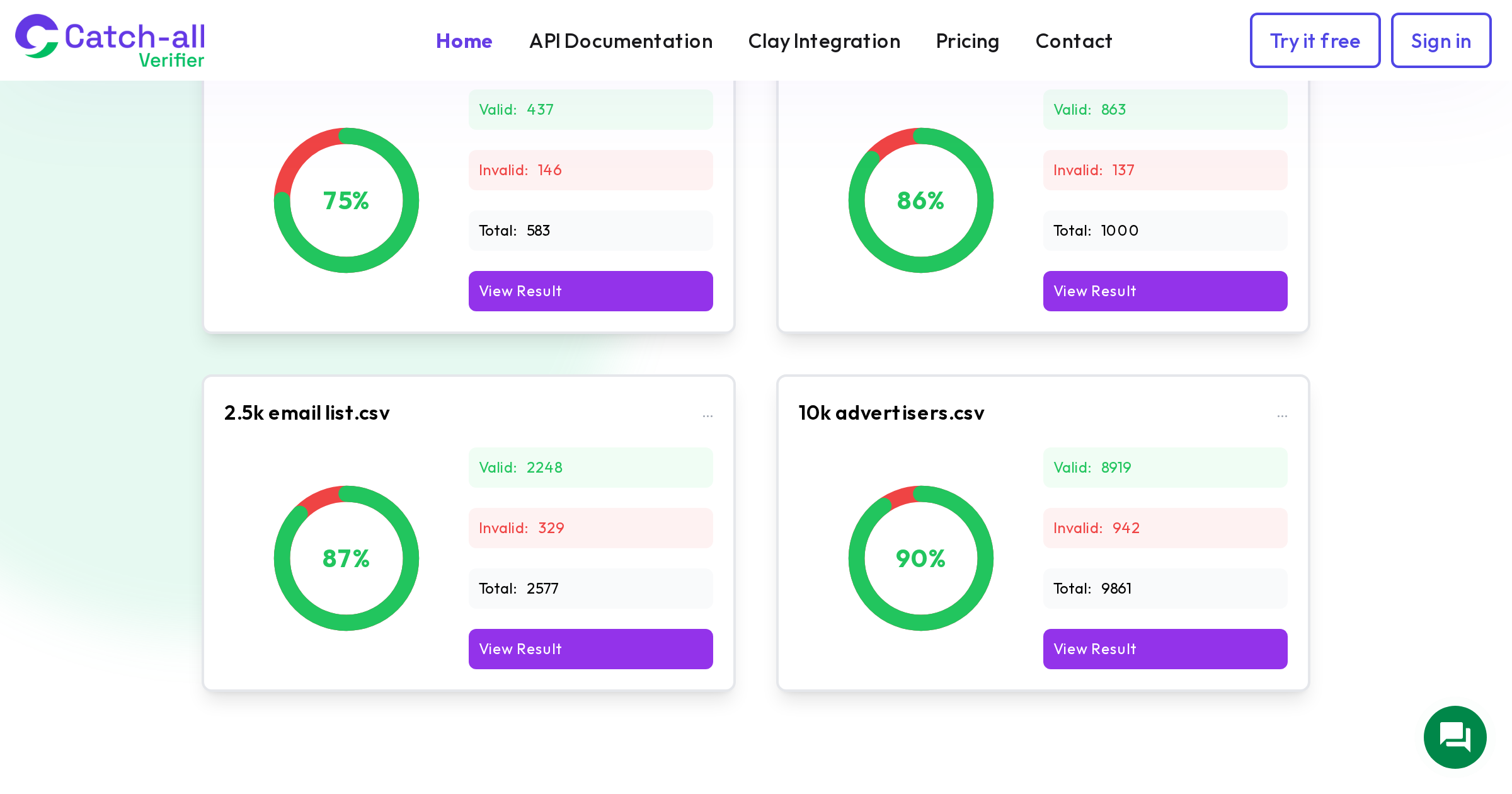
When CatchallVerifier tested a batch of 1,000 emails sourced from Apollo, 86 percent came back as valid. That is close to Apollo's claimed 91 percent, but the gap matters at scale. On a list of 10,000, that 5 percent difference represents 500 addresses that Apollo marks as good but that will actually bounce. If those 500 bounces happen in the first week of your campaign, your sender reputation takes damage that can take weeks to recover from.
ZoomInfo follows a similar pattern. Their verification pipeline is robust for standard domains but treats catch-all addresses the same way every other general-purpose tool does. The address gets a green light because the server accepted it, regardless of whether anyone is actually checking that inbox.
Why This Matters More Than You Think
The safe bounce rate threshold is generally considered to be below 2 percent. Ideally, you want to stay under 1 percent. When you send to a list where 25 to 35 percent of addresses are unresolved catch-all, your actual bounce rate becomes unpredictable. Some catch-all domains deliver everything to a central inbox. Others silently discard messages to nonexistent mailboxes. Still others bounce them after a delay, generating hard bounces that hurt your reputation.
Gmail requires spam complaints to stay below 0.3 percent for all senders. For high-volume senders pushing 5,000 or more messages per day, the threshold drops to 0.1 percent. Bounces from catch-all addresses contribute to these complaint calculations indirectly, because bounced messages signal to mailbox providers that your list is not well-maintained.
The financial cost is real too. If your sales team books meetings at a 2 percent rate from cold email, and you are losing 15 percent of your sendable list to unresolved catch-all bounces, you are leaving roughly 15 percent of potential meetings on the table. For a team running 10,000 emails per month, that could be 30 missed meetings per year. At an average deal value of $10,000 to $50,000, the pipeline impact runs into hundreds of thousands of dollars.
How to Close the Verification Gap
The fix is not to stop using Apollo or ZoomInfo. These platforms are valuable for finding contacts and building prospect lists. The fix is to add a second verification layer specifically designed to handle catch-all domains.
Here is the workflow that eliminates most post-enrichment bounces:
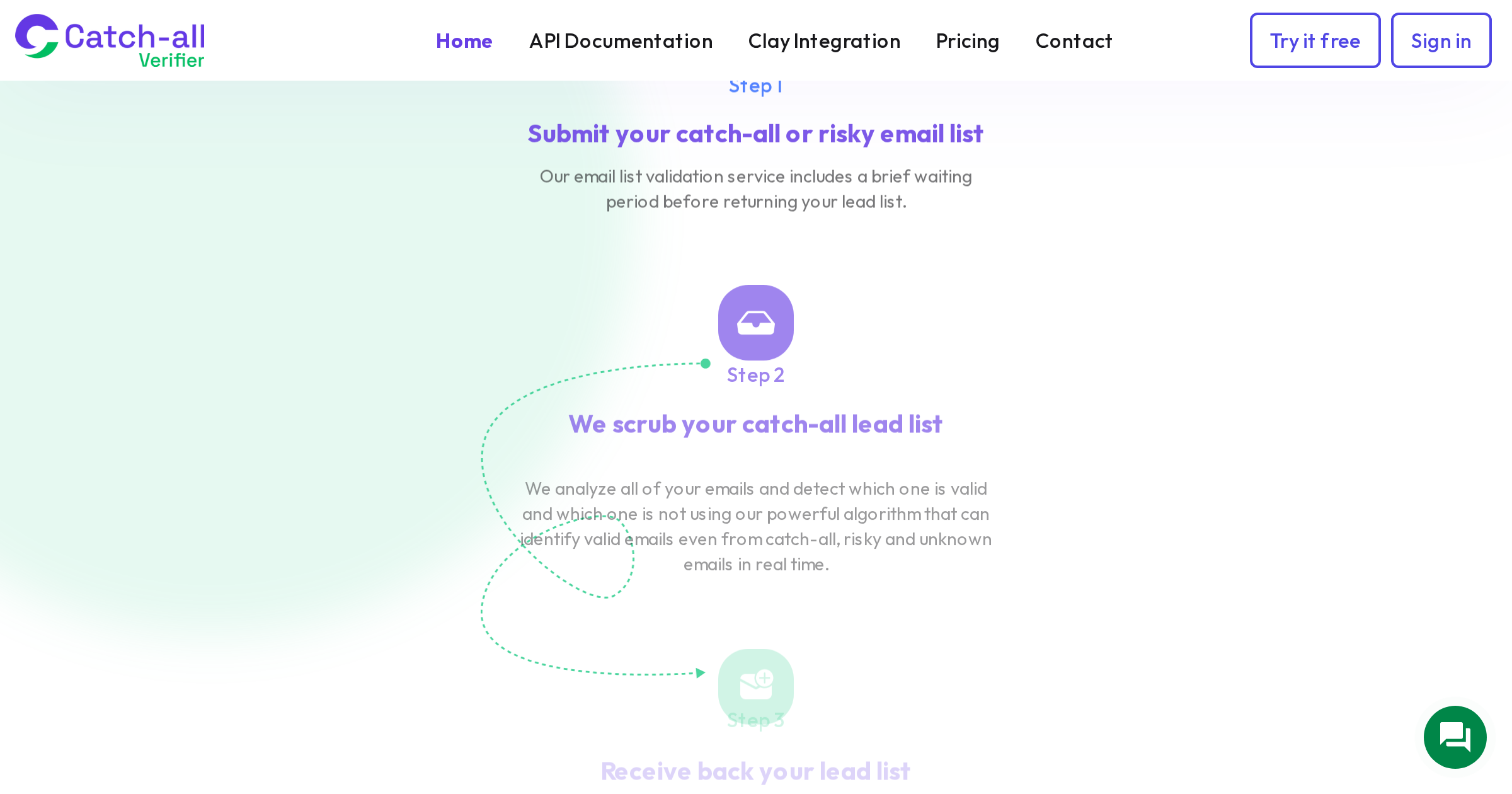
- Step 1: Export your lead list from Apollo, ZoomInfo, or whatever enrichment tool you use.
- Step 2: Run the full list through a standard email verification service. This catches any addresses that have gone invalid since the enrichment platform last checked them. B2B email lists decay at 2.1 percent per month, so even a list pulled last month may have some newly invalid addresses.
- Step 3: Isolate everything flagged as catch-all from the standard verification results. This is typically 20 to 35 percent of a B2B list.
- Step 4: Run the catch-all segment through a specialized catch-all verification tool like CatchallVerifier. This resolves individual mailboxes at catch-all domains, separating the truly deliverable from the dead addresses.
- Step 5: Merge results back together. You now have a list where every address has been verified at the mailbox level, not just at the domain level.
The Cost-Benefit Math
CatchallVerifier pricing starts at about $0.005 per verification at the higher volume tiers. If you are running 2,000 catch-all addresses through verification each month, that is roughly $10. Compare that to the cost of burning a domain (new domain purchase, 4 to 6 weeks of warmup time, lost sending capacity during recovery) and the math is not even close.
On a typical catch-all list, 75 to 90 percent of addresses verify as deliverable. So out of 2,000 catch-all addresses, you recover 1,500 to 1,800 valid contacts that you would have either discarded or bounced on. That is 1,500 more prospects in your pipeline at a cost of $10.
Timing Your Verification
Email data has a shelf life. The 91 percent accuracy Apollo claims is measured at the moment they verify the address in their database. By the time you pull that lead and actually send to it, days or weeks may have passed. B2B lists decay at 22 to 30 percent per year, which works out to roughly 2 percent per month. A lead that was valid when Apollo checked it three months ago has about a 6 percent chance of being invalid now.
For best results, verify your leads as close to send time as possible. If you pull a list on Monday and plan to start sequences on Wednesday, verify on Tuesday. If you maintain a lead database that you send to over weeks or months, re-verify catch-all addresses every 60 to 90 days.
What About Real-Time Verification via API
If your team has technical resources, integrating a catch-all verification API directly into your enrichment pipeline eliminates the manual export-import cycle. When a new lead enters your CRM from Apollo or ZoomInfo, a webhook triggers real-time verification. The result comes back in seconds, and the lead is automatically tagged with its verification status before it enters any sequence.
This is especially useful for teams using Clay as their enrichment orchestration layer. Clay supports waterfall enrichment workflows where you can stack multiple data providers and add a catch-all verification step at the end. The catch-all check becomes part of the automated pipeline rather than a manual side process.
Reading Your Bounce Data to Diagnose the Problem
If you are not sure whether catch-all domains are the source of your bounce problems, look at your bounce reports by domain. Export your bounced addresses and group them by domain. If you see clusters of bounces at specific corporate domains, check whether those domains are catch-all. You can do this by sending a test to a clearly fake address at the domain (like test12345randomstring@domain.com). If the server accepts it, the domain is catch-all.
Common patterns that indicate a catch-all bounce problem:
- Bounces concentrated at a few large corporate domains rather than spread evenly across your list
- Addresses that your enrichment platform marked as verified but that bounce on first send
- Increasing bounce rates over time even though you are using the same data source
- Higher bounce rates when targeting enterprise accounts versus SMBs
Once you identify that catch-all domains are the root cause, the solution is straightforward. Add specialized catch-all verification to your workflow and the bounce clusters disappear. Your enrichment data becomes genuinely actionable instead of conditionally reliable.